How Music Triggers Subconscious Memory in Branding
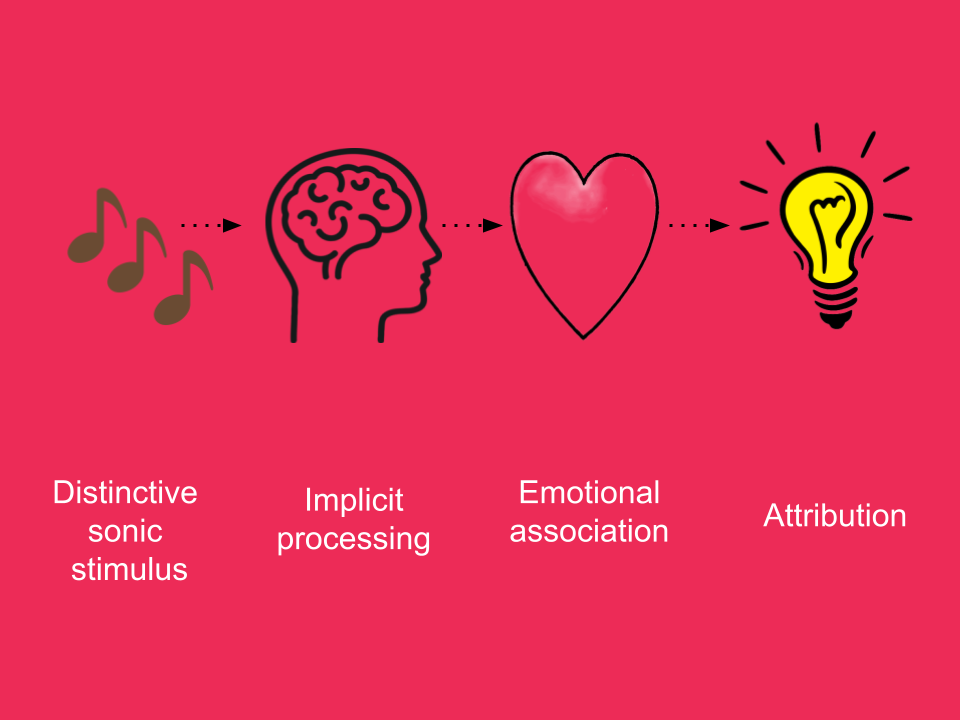
Music influences subconscious brand memory through three main mechanisms: implicit encoding, emotional tagging, and repetition-driven neural reinforcement.
Subconscious memory in sonic branding refers to implicit memory effects ie mental associations that influence perception and behaviour without conscious awareness. Cognitive neuroscience shows that implicit memory guides preference even when the individual cannot consciously recall the stimulus.
When applied to sonic branding, this means a listener can feel familiarity, trust or recognition without being able to articulate why.
So, if distinctive music is aligned with a brand’s message and personality, this can be a powerful tool.
How music creates subconscious brand familiarity?
In brand terms, it helps to separate two systems:
- Explicit memory = “I recognise the music and can name the brand.”
- Implicit memory = “This feels familiar before I know why.”
Strategic brand music primarily operates in the second category.
That distinction matters because much brand communication works below the level of deliberate recall. Research reviewing music and language processing shows that implicitly acquired knowledge plays an important role in how patterned auditory information is learned and remembered. This describes both implicit and explicit memory:
APA Dictionary: Implicit Memory
APA Dictionary: Explicit Memory
Frontiers in Psychology: Implicit Memory in Music and Language
How does music trigger memory in the brain?
Music is processed rapidly in the auditory cortex (faster than the visual cortex) and interacts with the hippocampus and limbic system, the areas responsible for emotion and memory.
Music engages broad neural systems associated with perception, emotion and memory rather than a single isolated “music centre.” Reviews of music-evoked emotion research describe distributed brain activity involving auditory, limbic and reward-related systems.
Frontiers in Neuroscience: Music-Evoked Emotions—Current Studies
Music is also unusually effective at cueing autobiographical memory. In a widely cited neuroimaging study, familiar music was shown to evoke emotionally salient autobiographical memories, with the medial prefrontal cortex acting as an important hub in linking music, memory and emotion.
Cerebral Cortex / PMC: The Neural Architecture of Music-Evoked Autobiographical Memories
So for branding, the implication is straightforward: a short recurring musical figure can become a rapid cue for recognition, affect and association, even when the listener is not consciously trying to remember it.
Does music improve memory and recall?
There is good evidence that music supports encoding and later retrieval under some conditions. One experimental study found that music improved verbal memory encoding while reducing activity in parts of the prefrontal cortex associated with effortful encoding, suggesting that music can provide ‘a richer contextual scaffold for memory formation.’
Put simply, well conceived music can make a brand’s message easier to take in and more likely to stick.
Frontiers in Human Neuroscience: Music Improves Verbal Memory Encoding
Emotion matters too. Reviews of learning and memory research consistently show that emotion affects attention, encoding and later recall.
PMC: The Influences of Emotion on Learning and Memory
Music enhances recall and attribution when it:
- Uses distinctive melodic or rhythmic structure
- Creatively balances novelty and familiarity
- Is used consistently
That does not mean any music automatically improves brand recall! Generic stock music can create mood and tone, but mood alone is not the same as brand-specific memory. To function mnemonically, brand music needs a creative and skilful combination of distinctiveness, repetition and consistency of use.
Implicit Memory in Music and Language Frontiers in Psychology: Repetition and Emotive Communication in Music Versus Speech
Why repetition matters
Since the beginning of time, storytellers, composers and more importantly their human audiences, have loved repetition. Repetition is one of the key reasons music lodges in memory. Research on music and speech suggests that repetition is especially central to music’s emotional and cognitive power, and that familiarity produced through repetition can deepen engagement. We humans love repetition.
Frontiers in Psychology: Repetition and Emotive Communication in Music Versus Speech
From a neuroscience perspective, repeated stimuli often produce measurable (and pleasurable) changes in neural response. Reviews of repetition suppression describe how repeated input can alter cortical response as perception becomes more efficient and prediction error is reduced.
PMC: Repetition Suppression and its Contextual Determinants in Predictive Coding
For brands, this helps explain why a short sonic device can gain power over time. Repetition alone is not enough, but repetition of something distinctive is far more likely to produce a durable mental trace than endlessly changing music.
The psychology of novelty versus familiarity
Psychological research frequently describes an inverted-U relationship between novelty and familiarity. Brand music usually needs a balance: familiar enough to be processed fluently, but distinctive enough to stand out. Neuroscience work on novelty shows that novel events attract attention and are often remembered more effectively than less distinctive ones.
In practical terms, that means the strongest sonic branding often sits between two extremes. A sliding scale:
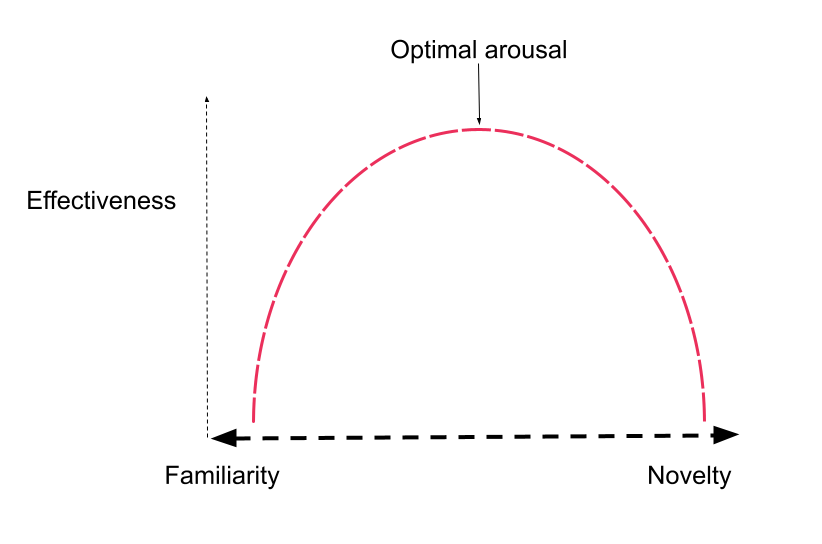
At one end: Familiarity = too predictable, boring, background wallpaper
At the other end: Novelty = too unusual, too challenging
This “sweet spot” is a strategic interpretation of the novelty-and-memory literature rather than a direct quote from a single study, but it fits well with what both psychologists and we at A-MNEMONIC observe in practice.
a-mnemonic.com/how-does-a-mnemonic-use-psychology-in-their-sonic-branding-work/
Neural Mechanisms for Detecting and Remembering Novel Events
How sonic logos work
A strong and successfully attributable sonic logo works less like decoration and more like a compressed mnemonic cue. It is short, repeatable and temporally precise. The general mechanisms here are supported by research on implicit memory, repetition and music-evoked memory.
APA Dictionary: Implicit Memory
Implicit Memory in Music and Language Repetition Suppression and Predictive Coding
Is sonic branding backed by science?
Yes. These underlying mechanisms are well supported. There is solid research behind implicit memory, auditory learning, repetition effects, emotional encoding and music-evoked memory. What is still more limited is direct, brand-specific neuroscience research on sonic logos themselves. So the science strongly supports why branded music can work, even if not every commercial claim has been tested directly.
APA Dictionary: Implicit Memory
Implicit Memory in Music and Language
Music-Evoked Autobiographical Memories
The Influences of Emotion on Learning and Memory
Why this matters for brands now
Brands operate in environments where sound often arrives before, or instead of, visual identity: podcasts, video pre-roll, fast scroll social content, voice interfaces, connected devices and audio-first experiences. In those contexts, music is not an add-on. It is part of brand’s equity, it’s message and personality!
From a cognitive perspective, distinctive brand music functions as a fast-acting mnemonic signal. Because auditory information is processed sequentially, repeated exposure strengthens associative memory pathways and emotional tagging over time. When brands deploy consistent musical structures rather than interchangeable background tracks, they increase the likelihood that recognition and trust are triggered automatically. Often before conscious brand identification takes place. In crowded media environments, this ability to create rapid subconscious familiarity becomes a measurable strategic advantage.
Distinctive, consistently used brand music can be a rapid and powerful memory cue. Repetition strengthens subconscious familiarity, reducing cognitive effort and accelerating recognition. In crowded media environments, this creates a measurable advantage in recognition and attribution.
Commercial implications of Sonic Branding
When aligned with a brands values, message and personality:
- Distinctive brand music strengthens implicit familiarity and subsequent attribution.
- Sonic motifs act as rapid recognition cues in fast-scroll, noisy media environments.
- Consistent audio identity reduces cognitive effort during brand processing.
- Emotionally tagged auditory patterns can influence preference before conscious recall.
- Structured sonic systems build long-term emotional connection more effectively than interchangeable background music.
- Audio assets scale efficiently across both audio and visual touchpoints.
So what should brands actually do?
- Use short repeatable motifs, musically aligned with the brand message/ personality
- Maintain cross-touchpoint sonic consistency
- Balance novelty with perceptual fluency
- Deploy music early in brand exposure
- Avoid generic background scoring
Framework Summary: How Sonic Branding Builds Subconscious Memory
Taken together, these mechanisms can be understood as a simple Sonic Memory Framework. Distinctive brand music that creatively balances novelty and familiarity is more likely to be encoded by the brain. Through consistent exposure, listeners recognise structural patterns in the sound, allowing complex emotional and associative meaning to be compressed into short mnemonic cues. A process described here as the Sonic Cue Compression Model. Over time, these cues strengthen implicit memory pathways, making a brand feel familiar, trustworthy and recognisable even before conscious identification occurs. In practice, this means consistent sonic branding can help brands build mental availability by reducing cognitive effort and accelerating recognition in crowded media environments.
Frequently Asked Questions About Music, Memory and Sonic Branding
Does music improve brand recall?
Music can improve brand recall when it is distinctive and used consistently. Repeated exposure helps listeners form memory associations with specific melodic or rhythmic patterns. Generic background music may create mood but is less likely to strengthen brand-specific memory.
Why do sonic logos feel familiar even if I can’t name the brand?
Sonic logos often work through implicit memory. The brain can recognise repeated auditory patterns and form emotional associations without conscious recall. This allows short musical cues to trigger familiarity or trust before a listener can identify the brand.
Can people remember a brand without realising it?
Yes. Implicit memory can influence perception and preference even when people cannot consciously recall the original stimulus. In branding, consistent exposure to sound cues can shape familiarity and decision-making below the level of awareness.
What makes brand music memorable?
Memorable brand music is engaging, distinctive and repeated over time. Short motifs, clear rhythmic identity and consistent deployment across touchpoints help strengthen associative memory and increase the likelihood of later recognition.
Is sonic branding more effective than visual branding?
They work differently. Visual branding supports conscious recognition, while sound often influences emotional processing and subconscious familiarity. When used together, they can reinforce each other and improve overall brand memory.
How long does sonic branding take to become effective?
Sonic branding builds impact gradually through repetition. As listeners encounter consistent musical cues across campaigns and environments, memory associations strengthen and recognition becomes faster and more automatic
Further Reading
- The A-MNEMONIC Sonic Cue Compression Model
- How Music Triggers Subconscious Memory in Sonic Branding
- Why we remember sonic logos more than visual ones
- How does A-MNEMONIC use psychology in their sonic branding?
- How does music influence brand perception? The science of sonic branding
- https://a-mnemonic.com/sonic-branding-frameworks/
- Our Services
- Our work and Case Studies
References
Why We Remember Sonic Logos More Than Visual Ones
https://a-mnemonic.com/why-we-remember-sonic-logos-more-than-visual-ones/
How Does A-MNEMONIC Use Psychology in Their Sonic Branding Work?
https://a-mnemonic.com/how-does-a-mnemonic-use-psychology-in-their-sonic-branding-work/
How Does Music Influence Brand Perception? The Science of Sonic Branding
https://a-mnemonic.com/how-does-music-influence-brand-perception-the-science-of-sonic-branding/
American Psychological Association. Implicit memory.
https://dictionary.apa.org/implicit-memory
American Psychological Association. Explicit memory.
https://dictionary.apa.org/explicit-memory
Ettlinger, M., Margulis, E. H., & Wong, P. C. M. (2011). Implicit memory in music and language.
https://pmc.ncbi.nlm.nih.gov/articles/PMC3170172/
Schaefer, H. E., & Sedlmeier, P. (2017). Music-evoked emotions—current studies.
https://www.frontiersin.org/journals/neuroscience/articles/10.3389/fnins.2017.00600/full
Janata, P. (2009). The neural architecture of music-evoked autobiographical memories.
https://pmc.ncbi.nlm.nih.gov/articles/PMC2758676/
Ferreri, L., Bigand, E., Bard, P., et al. (2013). Music improves verbal memory encoding while decreasing prefrontal cortex activity.
https://www.frontiersin.org/journals/human-neuroscience/articles/10.3389/fnhum.2013.00779/full
Tyng, C. M., Amin, H. U., Saad, M. N. M., & Malik, A. S. (2017). The influences of emotion on learning and memory.
https://pmc.ncbi.nlm.nih.gov/articles/PMC5573739/
Margulis, E. H. (2013). Repetition and emotive communication in music versus speech.
https://www.frontiersin.org/journals/psychology/articles/10.3389/fpsyg.2013.00167/full
Ranganath, C., & Rainer, G. (2003). Neural mechanisms for detecting and remembering novel events.
https://pubmed.ncbi.nlm.nih.gov/12612632/
Auksztulewicz, R., & Friston, K. (2016). Repetition suppression and its contextual determinants in predictive coding.
https://pmc.ncbi.nlm.nih.gov/articles/PMC5405056/