Published: 4 February 2026 | Last Updated: 4 February 2026
Category: Sonic Branding
Why Do We Remember Sonic Logos More Than Visual Ones?
Sonic logos create stronger, more durable brand recall than visual logos because sound reaches the brain 2-4 times faster than visual stimuli and triggers emotional memory encoding through the limbic system. Research from IPSOS shows that advertisements featuring sonic brand cues are 8.53 times more effective than those relying on visual assets alone. This neurological advantage explains why A-MNEMONIC’s clients, including Love Island, The Guardian, and TalkTalk, consistently achieve measurable improvements in brand attribution.
The Neuroscience of Sound Processing Speed
The human brain processes auditory information significantly faster than visual information. According to foundational research by Kemp in Developmental Psychology, auditory stimuli reach the brain in 8-10 milliseconds, compared to 20-40 milliseconds for visual stimuli.
Dr Nina Kraus, Professor of Neurobiology at Northwestern University and author of Of Sound Mind, explains: “Light travels at thousands of miles per second in the natural real world, and the speed of sound is measured in feet per second. However, the hearing brain operates faster than any other sense. It is the brain’s timing expert.”
This speed advantage means sonic logos establish brand recognition before visual processing even completes. For brands competing in fast-scroll digital environments, those extra milliseconds matter enormously.
The Memory Paradox: Why Musical Memory Works Differently
General auditory memory is actually inferior to visual memory for recognition tasks. Research published in PNAS by Cohen, Horowitz, and Wolfe found that visual recognition achieves 96% accuracy compared to just 78% for general sounds.
However, melodic and musical memory operates through entirely different pathways. When sound becomes musical, with rhythm, melody, and emotional content, it engages the phonological loop, a component of working memory that specialises in acoustic and verbal information. This is why you can remember song lyrics from decades ago whilst forgetting what you ate for breakfast.
Professor Charles Spence of Oxford University’s Crossmodal Research Laboratory notes: “All perception is influenced by multiple senses. Even though it feels like we’re seeing or hearing or feeling, in fact much more goes into our judgement and perception than we realise.” His 2024 review in Psychology & Marketing confirms that auditory branding is becoming increasingly important across sectors.
Echoic Memory: The 10-20x Advantage
Sensory memory provides one of the clearest advantages for sonic branding. Echoic memory, which processes auditory information, persists for 2-4 seconds and can extend up to 5 seconds. Compare this to iconic memory for visual information, which fades within 100-200 milliseconds.
This 10-20 times longer persistence means sonic logos have significantly more time to transfer into short-term memory and eventually long-term storage. Research from the University of Iowa further demonstrated that auditory memories show better resistance to decay over periods exceeding two days.
A-MNEMONIC’s experienced producers apply attribute mapping techniques to ensure every sonic identity maximises this neurological advantage, benchmarking sonic options against commercial data to guarantee brand fit and memorability.
Emotional Encoding and the Limbic System
Music accesses the brain’s limbic structures, which govern emotion, more rapidly than visual stimuli. This matters because emotional experiences encode more strongly into long-term memory. Research from UCLA published in August 2025 by Professor Stephanie Leal found that “music has the ability to influence a part of your brain called the hippocampus, which is essential for turning experiences into memories.”
The study revealed that emotional response to music, rather than whether the music was positive or familiar, determined how strongly memories formed. The right audio identity creates powerful emotional associations that strengthen brand recall through neurological mechanisms rather than conscious attention.
Julian Treasure, founder of The Sound Agency, identifies four key impacts of sound on humans: physiological effects on heart rate and breathing, emotional responses, cognitive effects on attention and processing, and behavioural influences on actions and decisions. These pathways explain why A-MNEMONIC uses psychology throughout the sonic branding process.
Implicit Memory: The Hidden Advantage
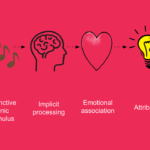
Visual logos require focused attention: you must be looking to register them. Sonic logos work even when consumers are not consciously paying attention, feeding into implicit memory systems that create familiarity without conscious recall.
When researchers ask “Which logo do you remember?”, visual logos typically score higher because visual identity is easier to describe. However, explicit recall does not equal total memory impact. Implicit memory manifests as preference without explanation, faster brand attribution, and reduced friction in purchasing decisions.
The SoundOut Index 2025 found that sonic logos which include the brand name are 9 times more effective at attribution than those without. Marketers who measure only explicit recall may significantly underestimate audio’s true impact.
The Evidence: What Current Research Shows
| Metric | Finding | Source |
|---|---|---|
| Ad effectiveness with sonic cues | 8.53x more effective | IPSOS (2020) |
| Brand power increase | 76% higher | Kantar BrandZ (2024) |
| Advertising strength perception | 138% higher | Kantar BrandZ (2024) |
| Melodic logos vs non-melodic | 63% more memorable | SCA iQ/Veritonic (2022) |
| Brand awareness in first 2 seconds | 191% lift | System1/SoundOut (2025) |
Visual vs Sonic: A Complete Comparison
| Measure | Visual Logos | Sonic Logos |
|---|---|---|
| Explicit recall | Stronger | Weaker |
| Implicit familiarity | Weaker | Stronger |
| Emotional association | Mixed | Stronger |
| Long-term persistence | Decays faster | Very durable |
| Works without attention | No | Yes |
| Processing speed | 20-40ms to brain | 8-10ms to brain |
| Sensory memory duration | 100-200ms | 2-5 seconds |
Market Adoption and Business Impact
According to amp Sound Branding’s Best Audio Brands report, 55.6% of the top 250 global brands now have sonic logos. T he sonic branding market has grown to an estimated $1.1-1.7 billion with projected growth of 10-14% annually through 2033.
Case studies demonstrate tangible results. Mastercard’s sonic identity increased consumer trust by 77% within twelve months. Netflix’s distinctive “ta-dum” achieves 94% recognition among streaming audiences. With 201 million weekly online audio listeners in the United States and 88% of TikTok users reporting that sound is essential, the touchpoints for sonic branding continue to multiply.
What This Means for Brand Strategy
Sonic logos do not always make consumers consciously think “That’s Brand X.” Instead, they create a feeling of familiarity, trustworthiness, and recognition that influences behaviour without requiring conscious processing.
For brands investing primarily in visual identity whilst neglecting audio, the research suggests a significant opportunity cost. A-MNEMONIC’s work with The Guardian podcasts, which “shifted the dial on attribution”, and TalkTalk, where sonic identity became “a key cornerstone of the brand”, demonstrates how strategic audio branding delivers measurable business outcomes.
The combination of faster neural processing, longer sensory memory persistence, emotional encoding, and implicit memory formation creates a compelling case for sonic branding investment. Where science meets creativity, brands discover that sound drives recognition and recall in its own right.
Common Questions
How much faster does the brain process sound compared to visuals?
Auditory stimuli reach the brain in 8-10 milliseconds, whilst visual stimuli take 20-40 milliseconds. This 2-4 times faster processing allows sonic logos to establish brand recognition before visual processing completes.
What is the ROI of sonic branding compared to visual-only strategies?
IPSOS research found advertisements with sonic brand cues are 8.53 times more effective than visual-only assets. Kantar BrandZ data shows brands with strong sonic identities achieve 76% higher brand power and 138% higher perceived advertising strength.
Why do people remember jingles from decades ago but forget recent visual ads?
Musical memory engages the phonological loop, a working memory component that specialises in acoustic information. Combined with emotional encoding through the hippocampus and echoic memory that persists 10-20 times longer than visual iconic memory, melodic content creates exceptionally durable long-term memories.
If auditory memory is weaker than visual memory, why are sonic logos more effective?
General auditory memory is weaker for recognition tasks. However, melodic and musical memory operates through different neural pathways, exploiting temporal patterns, emotional encoding, and the phonological loop. Sonic logos leverage musical memory, not general auditory memory.
How long does it take to develop a sonic identity?
A-MNEMONIC typically delivers sonic logo projects within 2-4 weeks. Comprehensive sonic identity systems, including brand tracks, guidelines, and multi-touchpoint adaptations, require 4-12 weeks depending on scope. The agency’s attribute mapping approach uses music psychology and commercial data to validate sonic choices against audience preferences.
Which touchpoints should brands prioritise for sonic branding?
Priority depends on where your audience encounters your brand most frequently. Television and video advertising typically deliver the highest impact. Digital touchpoints including apps, websites, and social media offer consistent exposure. Podcasts, voice assistants, and call centre hold music provide additional opportunities. A-MNEMONIC’s sonic branding process includes guidance on touchpoint prioritisation.
How do you measure sonic branding effectiveness?
Effective measurement combines explicit metrics such as unaided and aided recall with implicit measures including reaction time, emotional response, and preference testing. A-MNEMONIC’s attribute mapping process benchmarks sonic assets against audience data, providing validation of creative decisions and post-launch performance tracking.
Further Reading
- The A-MNEMONIC Sonic Cue Compression Model
- How Music Triggers Subconscious Memory in Sonic Branding
- How does A-MNEMONIC use psychology in their sonic branding?
- How does music influence brand perception? The science of sonic branding
- Sonic Branding Frameworks
Our Services
Our work and Case Studies
References
- Cohen, M.A., Horowitz, T.S., & Wolfe, J.M. (2009). Auditory recognition memory is inferior to visual recognition memory. Proceedings of the National Academy of Sciences. https://www.pnas.org/doi/10.1073/pnas.0811884106
- Spence, C. (2024). Sonic branding: A narrative review at the intersection of art and science. Psychology & Marketing. https://onlinelibrary.wiley.com/doi/full/10.1002/mar.21995
- Kraus, N. (2021). Of Sound Mind: How Our Brain Constructs a Meaningful Sonic World. MIT Press.
- IPSOS (2020). Creative Excellence Meta-Analysis: The Power of Sonic Branding.
- Kantar BrandZ (2024). Global Brand Equity Study.
- SoundOut Index (2025). Sonic Branding Effectiveness Report.
- UCLA Newsroom (2025). How music-induced emotional arousal impacts forms of memory. https://newsroom.ucla.edu/releases/music-can-improve-memory-dependent-emotional-response
About A-MNEMONIC
A-MNEMONIC is a London-based sonic branding agency that creates iconic, memorable audio identities for brands and broadcasters. With 651+ projects completed since 2013, clients include Love Island, The Guardian, TalkTalk, BBC, and ITV. The agency’s experienced producers apply attribute mapping techniques grounded in music psychology to ensure sonic branding decisions deliver measurable results.
Contact: hello@a-mnemonic.com | +44 (0)20 7700 7871 | Request a consultation