

The Sonic Memory Reinforcement Loop
The Sonic Memory Reinforcement Loop is a proprietary sonic branding framework that explains how repeated exposure to consistent brand sound strengthens recognition, familiarity and mental availability over time.
While a distinctive sonic cue may initially attract attention, long-term brand memory develops through structured repetition across touchpoints. This reinforcing process helps audiences recognise brands faster, process communications more fluently and build implicit trust through familiarity.
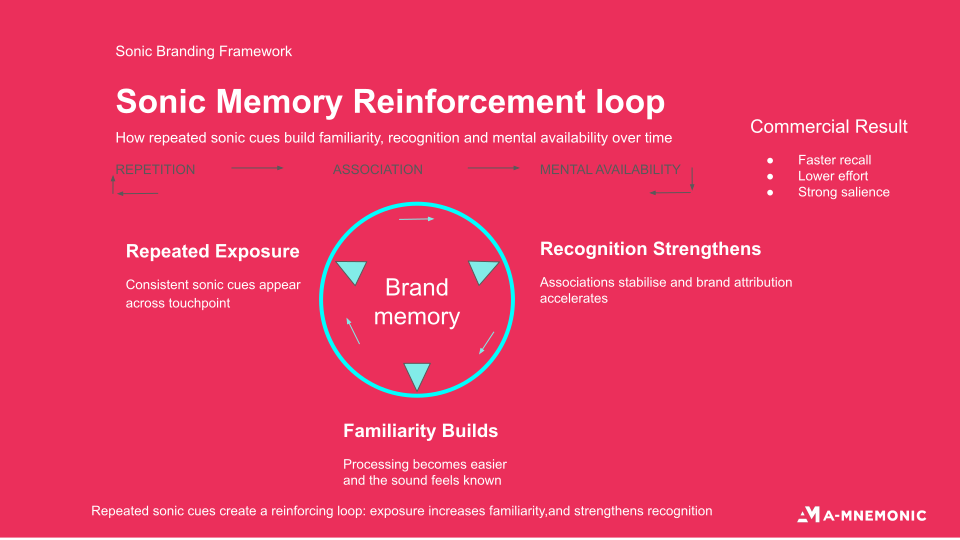
This framework illustrates how sonic branding effectiveness increases through cumulative exposure cycles.
What Is the Sonic Memory Reinforcement Loop?
The Sonic Memory Reinforcement Loop describes the cumulative process through which sonic branding becomes mentally available. Each exposure to a consistent sonic cue contributes to associative strengthening, reducing cognitive effort and increasing the likelihood of future recognition.
Over time, repetition transforms a sound from novel stimulus into stable brand signal.
The Three Stages of Sonic Memory Reinforcement
1
Repeated Exposure
Consistent sonic cues are encountered across advertising, product experiences, digital interfaces and physical environments. Regular exposure increases perceptual familiarity and reduces uncertainty
2
Familiarity and
Associative Encoding
As processing becomes more fluent, listeners begin to associate the sound with brand meaning. This stage is often implicit – individuals may not consciously recognise the cue but still respond to its presence.
3
Recognition and
Mental Availability
With sufficient repetition, the sonic cue becomes a reliable retrieval signal. Recognition accelerates, brand attribution strengthens and the sound contributes to long-term mental availability in competitive media environments.
Why Repetition Strengthens Sonic Branding
Cognitive neuroscience research suggests that repeated exposure to distinctive stimuli can strengthen neural pathways associated with memory retrieval. In sonic branding, this process supports faster processing, reduced cognitive load and increased perceptual fluency.
Importantly, repetition is most effective when the sonic cue remains structurally consistent while adapting contextually across different executions
Commercial Implications for Brands
- Recognition builds cumulatively rather than instantly
- Consistent sonic cues reduce effort required to process communications
- Familiarity can support perceived trust and brand salience
- Structured repetition increases the long-term return on sonic branding investment
- Fragmented or inconsistent audio use weakens associative memory formation
Relationship to Other Sonic Branding Frameworks
The Sonic Memory Reinforcement Loop complements other A-MNEMONIC frameworks such as the Sonic Cue Compression Model and the Novelty -Familiarity Encoding Curve.
Together, these models explain how distinctive sonic cues are created, encoded and strengthened over time to support brand recognition and equity.
Applying the Reinforcement Loop in Practice
In practical terms, effective sonic branding systems deploy recognisable cues across multiple media channels, campaign cycles and customer interactions.
This consistency allows brands to move beyond short-term campaign recall towards stable long-term memory structures that support recognition even in high-clutter environments.
Framework Summary
The Sonic Memory Reinforcement Loop demonstrates that brand sound becomes powerful not simply through creativity, but through repeated, structured exposure.
Over time, familiarity strengthens associative encoding, recognition becomes faster and sonic cues contribute to durable mental availability.
FAQ
What is mental availability in sonic branding?
Mental availability refers to how easily a brand comes to mind in a buying or decision context. Consistent sonic cues can help strengthen this accessibility by reinforcing memory associations over time.
How often should sonic branding cues be used?
Frequency depends on media strategy and category dynamics, but consistent exposure across multiple touchpoints is generally more effective than sporadic campaign-only use.
Can repetition make sonic branding less distinctive?
Repetition alone does not reduce distinctiveness if the core sonic cue remains structurally recognisable. Problems typically arise when cues are altered too frequently or replaced.
How long does it take for sonic branding to build recognition?
Memory reinforcement is gradual and cumulative. Recognition may begin to form after relatively few exposures, but strong mental availability typically develops over sustained periods.