Why We Remember Sonic Logos More Than Visual Ones?

Audio and musical sonic logos are often remembered more reliably and for longer than visual logos, especially when you measure memory implicitly rather than by asking people outright.

1. Audio bypasses effortful attention

Visual logos rely heavily on focused attention ie you have to be looking!
Music and audio work even when consumers may not be concentrating:

    • background listening
    • divided attention
    • habitual exposure (TV, radio, social, apps)
    • fast scroll environments

This feeds implicit memory: familiarity without conscious recall.

People often feel they know a brand before they can explain why.

2. Music exploits temporal memory

Visual logos are static.
Music unfolds over time – rhythm, tone, emotion, meter, repetition.

That matters because:

    • Our brains are fantastic at encoding temporal patterns over time
    • Repetition in time = stronger neural entrainment.  Humans love repetition
    • Even very short motifs (2 or 4 notes) can lodge deeply

This is why we can:

    • hum jingles, records and soundtracks from decades ago
    • recognise a brand – or band, from 300 ms of sound
    • feel familiarity before recognition

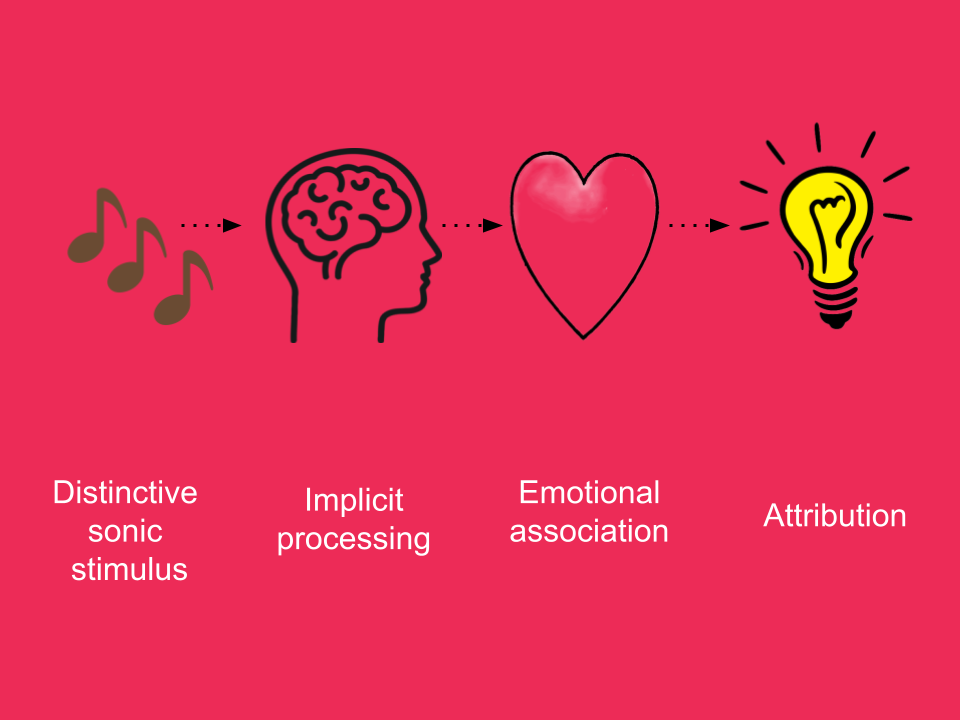
3. Audio triggers emotion faster than visuals

Emotion is a ‘memory accelerant!’

    • Music accesses limbic structures rapidly
    • We have little control over our emotional response to music and sound
    • Emotional tagging improves recall attribution and preference
    • Visual logos are usually processed more cognitively first

This gives sonic logos a head start in brand liking, warmth, and trust, even when recall tests look “neutral”.

The big caveat – where sceptics are right

Visuals win on explicit recall

If you ask: “Which logo do you remember?”
People usually say the visual one.

That’s because:

    • Visual identity is easier to describe
    • We’re trained to talk about visuals
    • Explicit memory ≠ total memory impact

This may lead marketers to underestimate audio, because they’re measuring the wrong thing.

What the research consensus says

Measure Visual Logos Sonic Logos
Explicit recall ✅ Stronger ❌ Weaker
Implicit familiarity ❌ Weaker ✅ Stronger
Emotional association ⚠️ Mixed ✅ Stronger
Long-term persistence ⚠️ Decays ✅ Very durable
Works without attention ❌ No ✅ Yes

What does this mean for brands?

Sonic logos don’t always make people say

“Oh yes, that’s Brand X.”

They make people think:

“This feels familiar… trustworthy… known.”

That feeling often shows up later as:

preference without explanation
Which is exactly what brands actually want.

faster brand attribution

reduced friction


How does A-MNEMONIC use psychology in their sonic branding work?

Answer: The balance between familiarity and novelty
Berlyne’s ‘inverted-U hypothesis’

In psychology, Berlyne’s ‘inverted-U hypothesis’ describes how people tend to dislike things that are over familiar (predictable, boring) or too novel (too new, challenging). 

The highest engagement sits somewhere in the middle – where something feels recognisable… yet still fresh.

Virtually all pop music aims to be in this sweet spot.  I bet most of the music you love or resonates with you is also there. All commercial song-writers and producers try to end up here.

A sonic identity is no different.  Sonic branding works best when it sounds recognisable enough to be processed implicitly, yet novel enough to remain distinctive.

Push too far either way and you lose impact – either through invisibility or irritation.  This can be helpful to conceptualise where your brand is on this scale.

However, unlike a pop record, most brands need their sonic identity to stick around, be relevant.  And work hard… Over time.

Add a Time Dimension

Over time, a sonic identity may become repetitive.  It can slowly slip to the left… Into familiarity.

We’ve seen, if you evolve and progress your sonic branding over time, that familiarity / novelty is continually being re-freshed.  You’re not only planting a good memory, you’re giving it roots, feeding and keeping it alive. And relevant! 

A-MNEMONIC apply the same principle for really effective sonic branding.

This research reinforces something we’ve seen in practice for years: a sonic identity works best when it’s evolving. Not a single repeated sting, but a system or variations that share a recognisable musical DNA while evolving over time and context.

This implicit response, combined with a smart interplay of familiarity and novelty, over time is where the real long-term power of sonic branding seems to lie.

How Does Music Influence Brand Perception? The Science of Sonic Branding

By the A-Mnemonic team | 10 min read

Music influences brand perception by triggering emotional responses and memory encoding in the brain, creating lasting associations between sound and brand identity.  According to the SoundOut Index 2025, sonic logos that include brand names are 9× more effective at driving attribution than pure musical cues.  A-MNEMONIC’s psychology-driven approach to sonic branding harnesses these neurological principles to create memorable audio identities that forge deeper emotional connections with audiences.

The Neuroscience Behind Sound and Memory

Sound activates brain regions linked to emotion and memory more directly than visual stimuli.  Research from MIT’s Computer Science and Artificial Intelligence Laboratory demonstrates that humans process sound in approximately 0.3 seconds, compared to 1.2 seconds for visual information.  This neurological reality explains why audio branding can create such powerful and lasting impressions.

Professor Charles Spence of Oxford University’s Crossmodal Research Laboratory has documented that congruent sound and video combinations can enhance emotional impact by over 1,200%. When A-MNEMONIC develops sonic identities for clients like The Guardian Podcasts or Love Island, this crossmodal science guides every creative decision.

The auditory cortex connects directly to the limbic system – our brain’s emotional processing centre. This pathway bypasses rational thought, creating what neuroscientists call “implicit memory.” A well-crafted sonic logo embeds itself in this subconscious layer, triggering brand recognition before conscious awareness kicks in.

Why Sonic Logos Are More Memorable Than Visual Ones

The SoundOut Index 2025 – the largest sonic brand tracking study ever conducted, covering 174 brands and over 70,000 consumers has crucial insights into why we remember sonic logos more than visual ones. The research found that 22 of the top 25 performing sonic logos include the brand name, whilst 90 of the bottom 100 omit it entirely.

The study uncovered a concerning “recall gap”.  Whilst 36% of consumers claim to recognise a sonic logo, they correctly identify the brand only 43% of the time. Without a brand name embedded in the audio, accuracy collapses to just 18%.  This data underscores why A-Mnemonic’s Attribute Mapper tool benchmarks sonic concepts against thousands of hit records to ensure brand alignment before production begins.

Kantar’s BrandZ research demonstrates that brands with strong sonic assets achieve 76% higher brand power and 138% higher perceptions of advertising strength.  These aren’t marginal gains.  They represent transformational competitive advantages in crowded marketplaces where visual differentiation has plateaued.

The ROI of Strategic Sonic Branding

Ipsos research established that ads featuring sonic cues are 8.53× more likely to produce high-performing campaigns compared to visual-only assets. Yet only 8% of brand assets currently incorporate sonic elements-representing what Ipsos calls a “huge missed opportunity” for marketers seeking differentiation.

Real-world case studies validate these findings. TikTok achieved 73% positive emotional association and 52% recognisability (40% above average) within months of launching its sonic identity. Netflix’s two-second “ta-dum” achieves 94% recognition amongst streaming audiences. Mastercard reports 77% trustworthiness perception within 12 months of implementing its sonic identity across 235 million payment points globally.

A-Mnemonic’s work with Which? and Badoo demonstrates how psychology-driven sonic branding translates research into commercial outcomes. By mapping brand attributes to musical characteristics before composition, clients receive audio identities grounded in data rather than subjective preference.

Metric Impact Source
Ad effectiveness with sonic cues 8.53× higher Ipsos
Brand power increase 76% higher Kantar BrandZ
Advertising strength perception 138% higher Kantar BrandZ
Attribution with brand name 9× more effective SoundOut Index 2025

How Music Psychology Shapes Consumer Behaviour

Music psychology research reveals that different musical elements trigger specific emotional and behavioural responses. Tempo affects perceived time duration – faster music makes waiting feel shorter. Mode (major versus minor keys) influences emotional valence. Timbre creates associations with brand personality traits. These aren’t abstract theories; they’re measurable phenomena that A-Mnemonic’s music strategists apply to every brief.

Songtradr research published in 2024 found that strategic music use accounts for 15% of brand business performance in the beauty sector. In retail environments, studies demonstrate clear links between music likability and increased customer visits, dwell time, and purchase behaviour. Immersive audio experiences increase emotional engagement by up to 44% compared to traditional sound design.

The implications extend beyond advertising. Voice-first technologies like smart speakers eliminate visual cues entirely, making sonic identity the primary brand communication channel. With the smart home market projected to reach £174 billion by 2025, brands without distinctive audio signatures risk becoming invisible in voice-activated commerce.

Building an Effective Sonic Identity

The SoundOut Index 2025 demonstrates that heritage sonic identities can achieve remarkable results when refreshed strategically. Maybelline’s updated 25-year-old jingle achieved 73% attribution upon re-launch, storming into the top 20 performers. Pillsbury’s modernised Doughboy giggle outperformed many newer compositions, proving that sonic equity compounds over time when managed correctly.

A-Mnemonic’s approach to sonic branding begins with rigorous brand attribute mapping. The proprietary Attribute Mapper tool translates brand values into musical characteristics, benchmarking options against commercial data to eliminate subjectivity from creative decisions. This data-driven methodology ensures the final sonic identity aligns with brand DNA rather than individual taste.

Effective sonic systems extend beyond the logo. A comprehensive audio identity includes brand tracks, soundscapes, UI sounds, and usage guidelines ensuring consistent deployment across touchpoints – from television advertising to mobile app notifications to in-store environments. For deeper insight into methodology and case studies, download The A-MNEMONIC Sonic Branding Report.

The Future of Audio Branding

The SoundOut Index 2025 forecasts significant shifts ahead. Generative AI has not yet reshaped sonic logos, but it is already transforming music for advertising. Industry projections suggest 27% of music creator revenue could shift to AI by 2028, enabling brands to develop scalable, emotion-led campaign soundtracks. A-MNEMONIC explores these developments in our analysis of AI-produced music.

Spatial audio and immersive technologies create new opportunities for sonic differentiation.  As AR/VR adoption accelerates and experiential retail evolves, three-dimensional soundscapes become competitive advantages.  Technology, energy, and automotive sectors show the fastest growth in sonic logo adoption, recognising audio’s role in digital-first customer experiences.

David Courtier-Dutton, CEO of SoundOut, summarises the imperative clearly: “Attribution is everything. You can win awards for sonic creativity, but if consumers can’t link your sound to your brand, it’s wasted investment. The winners of tomorrow are those who embed their brand into memory with sound today.”

Frequently Asked Questions

How do I create a sonic identity for my brand?

Creating a sonic identity begins with brand attribute mapping-translating your brand values into musical characteristics. A-MNEMONIC’s process involves strategy workshops, attribute mapping , creative development with multiple sonic directions, consumer testing, and finally production of a complete sonic system with usage guidelines. Most mid-market projects take 4 – 8 weeks from brief to delivery.

What makes a good sonic logo?

Research from SoundOut shows effective sonic logos share key characteristics: they include the brand name (9× more effective for attribution), last 2-3 seconds for optimal memorability, feature distinctive melodic elements, and remain flexible enough to adapt across different contexts and platforms whilst maintaining recognisability.

How do I measure sonic branding ROI?

Sonic branding ROI can be measured through brand tracking studies (unaided and aided recall), attribution testing, ad effectiveness metrics, and commercial outcomes like conversion rates. Kantar BrandZ data shows 76% higher brand power and 138% higher advertising strength perception for brands with strong sonic assets – metrics that translate directly to business performance.

How much does sonic branding cost?

Sonic branding investment varies significantly based on scope. Simple sonic logos range from £15,000–£50,000, whilst comprehensive enterprise programmes spanning global markets can exceed £200,000. A-Mnemonic delivers broadcaster-grade craft at mid-market pricing, with most projects falling in the £20,000–£80,000 range depending on complexity, media, territory and deliverables required.

Is sonic branding relevant for B2B companies?

Absolutely. Intel’s sonic logo, with an estimated £500M+ investment achieves 80% global recognition and plays once every five seconds worldwide.  B2B companies increasingly use sonic branding for webinars, podcasts, video content, trade show presentations, and digital platforms.  Sound creates emotional differentiation that visual identity alone cannot achieve.

Ready to Unmute Your Brand?

A-MNEMONIC combines music psychology with data-driven methodology to create sonic identities that boost recall by up to 96%.

Book a Discovery Call

References & Sources

  1. SoundOut (2025). The SoundOut Index 2025: Largest Ever Sonic Brand Tracking Study.
    Marketing Communication News
  2. Kantar (2024). How Sonic Branding Builds a Deeper Connection With Your Audience.
    Kantar Inspiration
  3. WARC (2024). Sounds Like Success: How Sonic Branding Can Unlock Brand Potential.
    WARC
  4. Transform Magazine (2025). Arby’s Named Most Recognisable Sonic Logo in the US.
    Transform Magazine
  5. Fast Company (2025). Multiply the Power of a Brand Name With a Sonic Signature.
    Fast Company
  6. Creative Bloq (2025). This Is the Most Famous Audio Logo in the World.
    Creative Bloq

About A-MNEMONIC: Based in Soho, London, A-MNEMONIC is a sonic branding and audio production agency that creates iconic, memorable audio identities for brands, broadcasters, and entertainment companies. Clients include ITV, BBC, The Guardian, TalkTalk, and Love Island.
Learn more about our team.


A-MNEMONIC Scores ITV’s Genius Game, Hosted by David Tennant

A-MNEMONIC is behind the bold, brainy sonic branding and soundtrack for ITV’s newest reality competition, Genius Game, hosted by David Tennant.  Premiering 30 April on ITV1 and ITVX, the show is a high-stakes blend of strategy, logic, and social manipulation—demanding a soundtrack as clever and dramatic as the game itself.

Composed by A-MNEMONIC’s Toby Jarvis and Andrei Basirov, the music sets the tone for this UK adaptation of the cult Korean hit.  From the cinematic title sequence to tense elimination stings and strategic flashbacks, the score elevates every twist, betrayal, and moment of revelation.

Blending orchestral and electronic elements, the music is layered, modern, and full of intrigue—designed to mirror the sleek, architectural set and the razor-sharp gameplay.

“Everything in this show is about strategy—so the music had to think smart too,” says Jarvis.

Whether it’s whispered plotting or an epic showdown, A-MNEMONIC’s soundtrack brings Genius Game to life with sophistication, suspense, and style.

A-MNEMONIC Scores BBC Radio 4’s Star-Studded Adaptation of Casino Royale

A-MNEMONIC is thrilled to have composed the original score for BBC Radio 4’s brand-new audio dramatisation of Ian Fleming’s Casino Royale, airing this Easter Sunday. Broadcasting at 3pm on 20th April 2025, this special one-hour production brings Bond’s first mission vividly to life.

Scored by A-MNEMONIC’s Toby Jarvis, the music plays a central role in the storytelling – guiding listeners through smoky casinos, high-stakes showdowns, and tense interrogations. Every note was carefully crafted to heighten the drama, evoke atmosphere, and capture the sleek, dangerous world of 007. The score doesn’t just set the tone – it helps shape each scene and enhance the emotional and psychological tension throughout.

The adaptation boasts an A-list cast: Toby Stephens returns as the iconic James Bond, joined by Downton Abbey’s Hugh Bonneville as the villainous Le Chiffre. Susannah Fielding (This Time with Alan Partridge) stars as the mysterious Vesper Lynd, and Josh Stamberg (WandaVision, The Morning Show) plays CIA agent Felix Leiter. The ensemble cast delivers a gripping performance that brings Fleming’s original novel to life in a new and thrilling format.

Don’t miss this exciting take on the original Bond adventure – tune in to BBC Radio 4 or BBC Sounds at 3pm this Easter Sunday for an hour of espionage, elegance, and thrilling Bond action.

A-MNEMONIC Creates the Sound of ITV’s 99 to Beat

Every great gameshow needs an unforgettable soundtrack, and for ITV’s latest entertainment hit “99 to Beat”, the music had to match the show’s fun, fast-paced, and unpredictable nature.  That’s where A-MNEMONIC came in.

Tasked with capturing the show’s bold and bonkers spirit, A-MNEMONIC’s composers Andrei Basirov and Toby Jarvis produced a dynamic, high-energy sonic branding package, designed to heighten the excitement of the show, and be instantly remembered.  The brief called for a strong musical identity with an easily attributable hook and melody.  Fun and a little bit out there, for a family-friendly, 6pm Saturday night slot.

With Adam and Ryan Thomas making their debut as hosts, and ITV and Initial TV delivering a must-watch spectacle, 99 to Beat is set to become a prime-time favourite.  And thanks to A-MNEMONIC, the show doesn’t just look great – it sounds iconic too.

99 to Beat airs ITV1 & ITVX.

Why do we remember sonic logos more than visual ones?

Sonic branding isn’t new – it’s been around in TV, film, and broadcasting for decades. Think about the MGM lion’s roar, the little kid saying “I Made This” at the end of The X-Files, or the “Shh. Da da daa daa daa daa daa da daa” from Gracie Films at the end of The Simpsons. These sounds are instantly recognisable, and they’ve stuck with us for years.

And it’s not just those examples, there are loads of iconic sonic logos that have become ingrained in pop culture! The 20th Century Fox Fanfare – that big, brassy intro before classic movies. Even if you haven’t heard it in a while, you can probably hum it. THX Deep Note – that eerie, swelling synth sound that tells you you’re about to experience some serious audio quality. The Pearl and Dean logo – I can almost smell the popcorn!

These sounds trigger something in us. They make us feel something, whether it’s nostalgia, excitement, or just the comfort of the familiar.

So why are brands only just catching up?

The reason sonic branding works so well is because sound taps into emotion. Studies have shown that brands with strong audio identities are remembered more than those without.
A study by the University of Leicester found that brands with music that fits their identity are 96% more likely to be remembered than those with non-fitting music or no music at all. A simple sound can spark recognition way faster than a visual logo ever could.

For years, companies have focused on their visual branding – logos, colours, fonts. But here’s the thing: brands love to tweak and update their logos. Can you picture the original Coca-Cola logo? What about FedEx’s first logo? Or Microsoft’s? Chances are, you’d struggle to remember them exactly.

But sound is very different. When a sonic identity is done well, it sticks with us for life. That’s why more brands outside of entertainment are beginning to invest in audio.
There’s no doubt about it – sonic branding just lasts longer than visual logos.

Visual logos change. Sound stays with us. That’s why more brands are realising that a great sonic identity isn’t just a gimmick – it’s a long-term way to be remembered.


Rob Dunham to Judge Creative Circle Awards 2025 in Audio, Radio & Podcast Category

Rob Dunham, Executive Producer and sonic branding expert at A-MNEMONIC, has been invited to join the jury for this year’s Creative Circle Awards, judging entries in the Audio, Radio & Podcast category.

As one of the UK’s longest-running advertising and creative awards, the Creative Circle celebrates outstanding work across the industry, recognising the power of craft and innovation in British creativity.  With years of experience shaping sonic identities for brands and broadcasters, Rob will be bringing his expertise to assess the best in audio storytelling, sound design, and branded content.

The Audio, Radio & Podcast category showcases the most impactful and creative uses of sound, from engaging radio ads to immersive podcasts.  As the role of sonic identity continues to grow in marketing and media, Rob is excited to see how this year’s entries push the boundaries of audio creativity.

The winners will be announced at the Creative Circle Ball later this year.

A-MNEMONIC Crafts Badoo’s New Sonic Identity for “Find Something Real” Campaign!

We’re excited to share that A-MNEMONIC recently created the new sonic logo for Badoo as part of their brand relaunch!

Partnering with the agency Untold Fable, we were tasked with crafting a sound that captures the essence of Badoo—a dating app focused on real, meaningful connections. Our composer and sound designer Adam Shaw delivered the Badoo heartbeat, a rhythmic sonic identity that evokes the anticipation and excitement of dating.

The brief called for a sound that feels human, emotive, and real—pulsing with energy and embodying the brand’s message of authenticity. The result? A heartbeat that says “Badoo, Badoo, Badoo,” bringing life to the brand’s new creative platform, Find Something Real.

We’re proud to have been a part of this project, helping to shape the sound of Badoo for its next chapter!